If you live in one of the high-rises near Republic Square, or on Rainey Street itself, your feet have probably already noticed something your brain hasn't caught up to yet. The walk toward the lake feels shorter this summer. You're waiting at fewer crosswalks. And somewhere around Cesar Chavez Street, the air actually drops a few degrees before you've made a single conscious decision about where to walk.
That's not a coincidence. It's Waterloo Greenway's Confluence segment, the $91.5 million restoration of Waller Creek between 4th Street and Lady Bird Lake that opened to the public on June 6, 2026. Most of the coverage around the opening focused on the ribbon-cutting and the new park amenities. The part that actually changes daily life downtown is quieter: this project rerouted the most-walked path in the neighborhood, and it did it in a way that has nothing to do with real estate and everything to do with how you already move through the day.
What Disappeared From the Walk
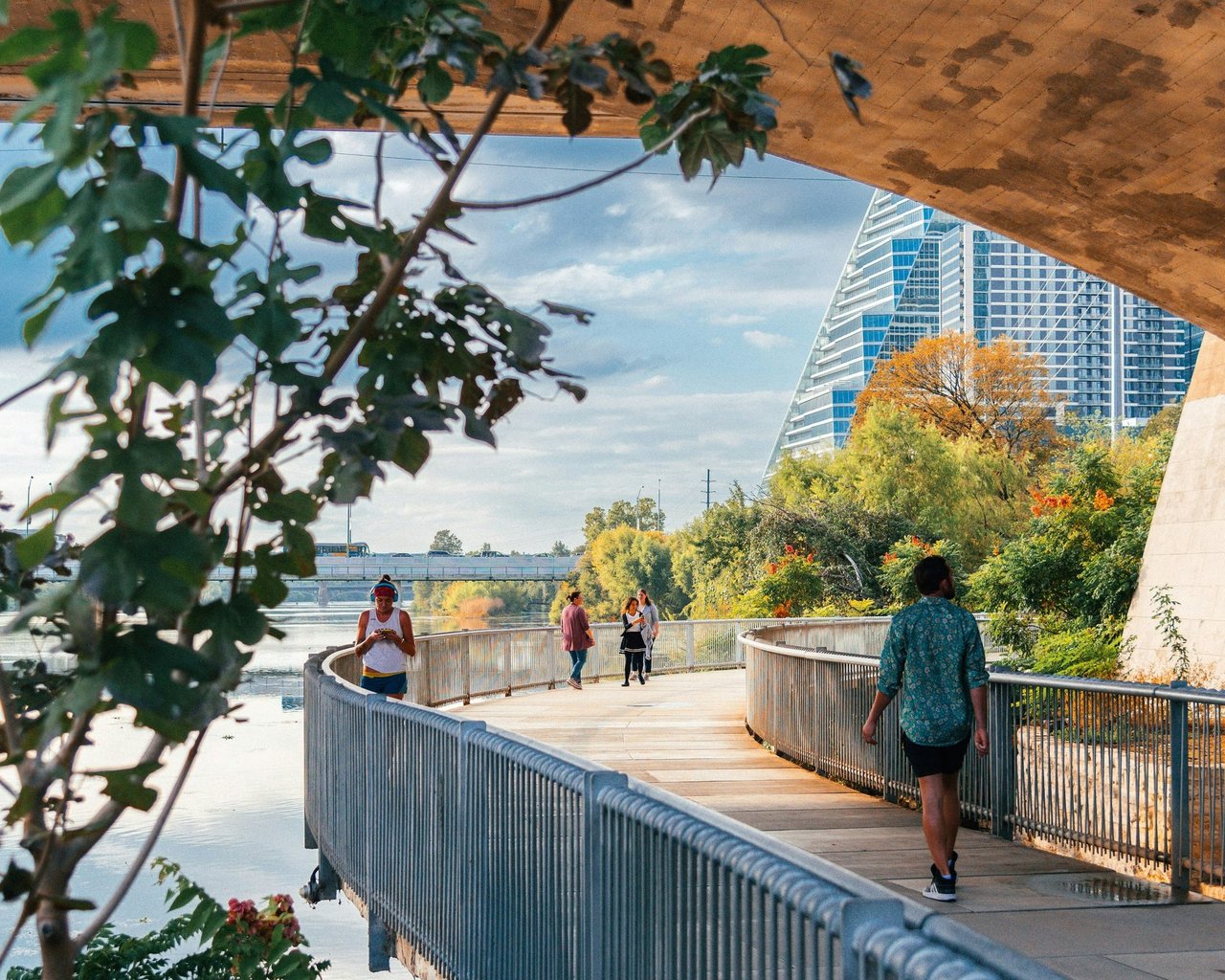
For years, getting from the convention center side of downtown to Rainey Street meant crossing Red River Street and Cesar Chavez Street at grade, which meant timing your steps to a signal and watching for turning cars. The Confluence replaced that at-grade crossing with an 800-foot boardwalk built directly into Waller Creek, engineered specifically so trail users can bypass both intersections entirely.
That boardwalk is one piece of a larger reroute. According to the City of Austin's official project page, the completed work also includes:
- Three lattice bridges providing new east-west crossings over Waller Creek
- A continuous off-street trail connecting the Lance Armstrong Bikeway, Palm Park, Rainey Street, and the Ann and Roy Butler Hike-and-Bike Trail
- A new Cypress Grove entrance at 4th Street
- Fully ADA-accessible paths to the Emma S. Barrientos Mexican American Cultural Center
None of that required a car, a permit, or a decision about where to live. It just changed how the stretch between Waterloo Park and Lady Bird Lake actually moves people, which is most of what a downtown week looks like anyway.
And a Few Degrees Cooler, Which Matters in August
Waterloo Greenway's chief planning and design officer, John Rigdon, told Community Impact that trail temperatures along the Confluence run five to seven degrees cooler than street level, a result of the creek's shade canopy and the nearly 1,600 new trees planted along the corridor. In an Austin August, with heat index numbers regularly clearing 110, that's not a landscaping footnote. It's the difference between walking to Rainey Street and driving there.
The Street the Route Now Feeds Into
Rainey Street sits at one edge of the Confluence, which puts it on the receiving end of all that rerouted foot traffic. The street has spent the past year answering the obvious question that creates.
Some of what's new: Alteño Austin, the latest project from Fonda Fina Hospitality's Johnny and Kasie Curiel, is bringing their Michelin-recognized Denver flagship into the Rainey district with fire-driven cooking rooted in the cuisine of Jalisco's Highlands. Kinsho opened as the street's first sushi restaurant. Modern Bar took the ground floor of The Modern Residences, with bar director Gabe Ford building a cocktail program drawn from Mexico City and London. Bar Hacienda arrived with a mezcal-forward menu built around drinks like the Hacienda Highball.
None of it replaced what was already working. Banger's Sausage House still runs one of the largest dog-friendly patios downtown, with more than 200 beers on tap. Half Step still pours some of the neighborhood's most exacting cocktails. Bar Fino's fenced-in patio is still the quiet option a few doors down from the noise. Emmer & Rye, a Michelin Green Star and Bib Gourmand recipient known for its heirloom-grain, cart-service menu, hasn't gone anywhere. Stay Put remains Rainey's only brewpub.
Matt Wolski, director of hospitality at LV Collective, the group behind the Paseo development on Rainey, described the shift to Tribeza this way: "Austin hasn't always had this version of a downtown, where living, working and going out all intersect in one place." That's a fair description of what the new trail connection actually does. It turns a street built for a Saturday night bar crawl into a place people also walk through on a Tuesday afternoon with a dog and a coffee.
Where the Neighborhood's Own Event Followed
Even Waterloo Greenway's signature event moved to keep up. Creek Show, the light-based art installation series that has illuminated Waller Creek every fall since 2014, spent a decade staged upstream near Waterloo Park. This November, after a one-year pause, Creek Show returns for the first time at the Confluence, running November 13 through 21, with new installations commissioned specifically for the reconstructed creek segment, each backed by a $20,000 production budget for the selected design teams.
That relocation is a small but telling detail. The event built around celebrating Waller Creek chose the Confluence as its new home the same year the trail opened to the public. It followed the same route everyone else downtown is now taking.
What This Actually Changes
None of this touches the fundamentals of living downtown. It changes the granular stuff: the choice between the sidewalk and the shade, the two lights you no longer wait at, the ten minutes you get back by not standing at a Cesar Chavez crosswalk in July. Changes like this tend to stick because they don't require anyone to decide anything. Your feet just start taking the new way.
If you're weighing what a home near this stretch of downtown is actually worth day to day, not just on paper, this is the kind of detail that belongs in the conversation, alongside square footage and views. Linda Miller has spent enough time on these blocks to know which changes downtown are cosmetic and which ones are structural. Let's Connect.